Too Loud to Categorize: How Hyperpop Broke the Algorithm and Why That's the Whole Point
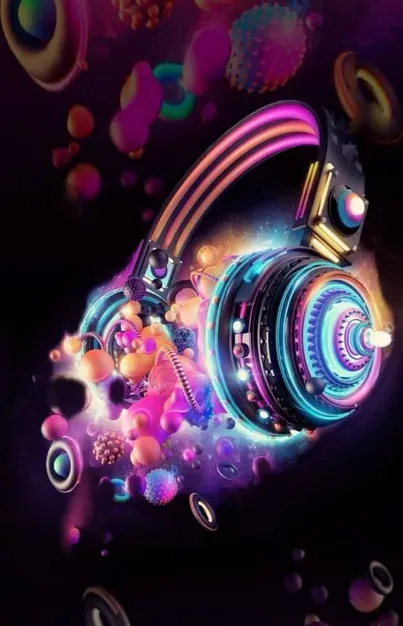
Photo: neon glitch art headphones digital abstract colorful chaos, via media.livewallpapers.com
Picture a song that sounds like a video game character having a panic attack in a candy factory — pitched-up vocals clipping into distortion, 808s that hit like a car crash, lyrics that oscillate between ironic detachment and raw emotional confession, all of it moving at a tempo that feels structurally opposed to human enjoyment. Now picture that song having 40 million streams.
Welcome to hyperpop. Or don't — the genre will survive your confusion.
Hyperpop is one of those cultural phenomena that's easier to experience than define, which is probably intentional. It emerged from the fringes of SoundCloud and Tumblr, got a brief moment of mainstream attention around 2020 and 2021, and then — when the think pieces started rolling in and Spotify made a playlist — did what all genuinely weird subcultures do when they get noticed: it mutated, fragmented, and got stranger.
The Algorithm as Opponent
To understand hyperpop, you have to understand what it's pushing against.
Streaming platforms like Spotify and Apple Music run on recommendation engines that are optimized for retention. They want you to keep listening. To do that, they've developed genre taxonomies — thousands of microgenres, mood playlists, radio stations — designed to slot every piece of music into a predictable category. The algorithm wants to know: if you like this, you'll like that.
Hyperpop resists this at a structural level. The genre borrows from PC Music's hyper-produced pop experiments, from the chaotic energy of early internet culture, from emo, from club music, from noise, from video game soundtracks — often within the same three-minute track. It's not eclectic in a chill, world-music way. It's eclectic in a way that seems designed to break classification systems.
And here's the thing: that's not an accident.
A lot of the producers and artists working in this space are deeply aware of how algorithmic recommendation works. They're not ignoring it — they're exploiting its gaps. A track that can't be cleanly categorized doesn't disappear; sometimes it gets passed around manually, organically, person to person, in ways that bypass the recommendation layer entirely. Which is, weirdly, how music used to spread before Spotify existed.
Discord Is the Label Now
If you want to understand where hyperpop actually lives, you need to get off the major platforms and into the Discord servers.
There are dozens of them — some with thousands of members, some with a few hundred committed weirdos — where producers share stems, critique each other's mixes, collaborate on tracks in real time, and collectively develop an aesthetic vocabulary that changes faster than any A&R rep could track. These aren't just fan communities. They're functional creative ecosystems.
The tools are cheap and accessible in ways they weren't even ten years ago. A teenager with a laptop, a cracked copy of FL Studio, and a Discord account can produce and distribute music that sounds genuinely alien — and find an audience for it before any label has even heard their name. This has always been theoretically true in the internet age, but hyperpop's community is one of the places where it's actually, practically happening at scale.
What's interesting is the aesthetic philosophy embedded in all of this. Hyperpop is deliberately ugly in ways that feel principled. The clipping, the distortion, the pitch-shifted vocals that sound like a chipmunk going through something — these aren't production mistakes. They're choices that signal insider membership, that say I know what polished mainstream pop sounds like and I'm choosing this instead.
The Gen Z Emotional Equation
It would be easy to dismiss hyperpop as ironic noise made by people who think sincerity is embarrassing. That reading misses something important.
A lot of the most resonant hyperpop tracks are emotionally raw in ways that conventional pop rarely manages. Artists like 100 gecs, Dorian Electra, and the late SOPHIE (whose influence on the genre is hard to overstate) made music that dealt with identity, dysphoria, loneliness, and desire with a kind of unfiltered directness that felt genuinely new. The sonic chaos isn't a shield against feeling — it's a delivery mechanism for it.
For a generation that grew up online, that learned emotional expression through memes and irony and extremely online communication styles, this makes a weird kind of sense. The music sounds like the internet feels — overwhelming, funny, kind of sad, moving too fast, occasionally beautiful in ways you can't quite explain.
When Mainstream Comes Knocking
Spotify's hyperpop playlist launched in 2020 and was, depending on who you ask, either a moment of legitimate recognition or the beginning of the end. The truth is probably somewhere in the middle.
The playlist introduced the genre to a wider audience, which brought in new fans and new creators. It also flattened the genre's edges in the way that algorithmic curation tends to do — surfacing the most accessible tracks, the ones closest to conventional pop structure, while the weirder stuff stayed in the Discord servers and SoundCloud rabbit holes where it had always lived.
Major labels took notice too. Several hyperpop-adjacent artists got signed, made more commercially viable records, and drifted toward something that sounds like hyperpop the way a theme park ride sounds like an actual adventure. Some of those artists are genuinely good. But the genre's center of gravity never really moved. It stayed underground, kept mutating, kept getting stranger.
This is actually a pretty elegant resistance strategy, even if it's not entirely conscious. You can't absorb something that won't hold still.
The Signal Underneath the Noise
Hyperpop is a weird thing to write about on a website called Izatioth, and also kind of a perfect thing. It's a subculture that found its signal in the gaps — in the spaces between algorithmic categories, between mainstream acceptance and underground obscurity, between sincerity and irony, between music and noise.
It's not for everyone. It's maybe not even for most people. But it's doing something genuinely interesting: demonstrating that in an era of total algorithmic mediation, there are still ways to make something that the machine can't fully process.
That's not nothing. In 2024, that might even be everything.