The Handshake We Keep: Why the Fax Machine Deserves Its Second Life
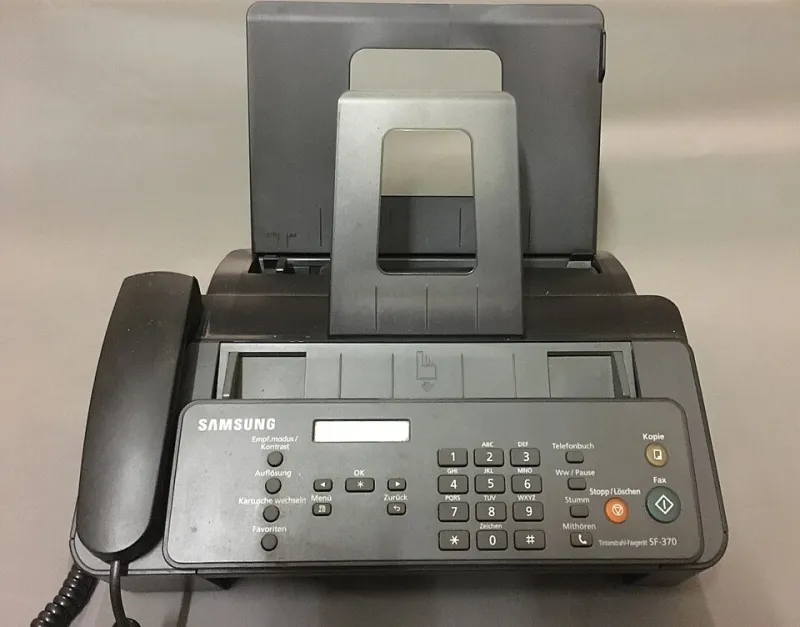
Photo: Pittigrilli, CC BY-SA 4.0, via Wikimedia Commons
The Screech Heard Round the Office
The fax machine should be dead. It has been pronounced dead since email, since PDFs, since the first cloud storage pitch deck. And yet, in 2026, if you walk into a hospital records department, a law firm, or a county clerk's office, you will find one. It will be beige. It will have a handset. It will screech. The fax persists because the systems around it persist — HIPAA rules, signature requirements, legacy software, and a hundred small bureaucratic habits that are easier to keep than to replace.
This is usually framed as a failure. The American healthcare system still faxes prescriptions and records. Courts still accept fax filings. The IRS still lists fax numbers. We are told this is embarrassing, a sign that our digital transformation is incomplete. I want to argue the opposite: the fax is a feature, not a bug. It is one of the last analog handshakes in a world of frictionless digital noise.
A Feature, Not a Bug
A fax is point-to-point. It does not go through a platform. It does not get indexed. It does not live in a cloud you do not control. When you send a fax, the machine on the other end picks up, negotiates a connection, and prints a page. You get a confirmation. The recipient gets a physical object. There is no attachment to phish, no link to click, no algorithm deciding who sees it. The friction is the security.
This is not a romantic argument for inefficiency. Faxes are slow, ugly, and prone to jamming. But in a world where every message is optimized, tracked, and monetized, the fax is a deliberate speed bump. It says: someone on the other end had to be there. It says: this document is a thing, not a stream. That is a strange kind of comfort.
The People Keeping the Line Alive
There is a small subculture of people who still run fax servers for fun. They use HylaFAX, Asterisk, and old modems. They send drawings. They send poems. They send a single black page to see if the machine on the other end will print it. They call it fax art, or fax poetry, or just 'sending a fax because it is funny.' The hobby is not about practicality. It is about the sound. The handshake tone is a relic, and relics have gravity.
Some of them run public fax numbers. You can send a drawing and they will post it online. The results are weird — smudged, low-resolution, beautiful in the way that a photocopy is beautiful. It is the opposite of a high-definition image. It is a signal that has been through something.
How to Send a Fax in 2026 Without Losing Your Mind
If you actually need to send one, you have options. E-fax services let you send a PDF from your laptop. A physical fax machine still works over a VoIP line, though the handshake can be finicky. The hobbyist route is a modem, a phone line, and a scanner. Cover sheets are still polite. Call ahead if you are sending to a small office. Do not fax strangers.
The Case for Keeping One Analog Handshake
The fax is not going to disappear anytime soon, and that is fine. It is a strange little signal in a noisy world. It refuses to be frictionless. It refuses to be silent. It prints. That is the whole argument. The handshake we keep is not nostalgia. It is a choice to slow down, to confirm, to make a sound that says: I am here, and so are you.